Overview
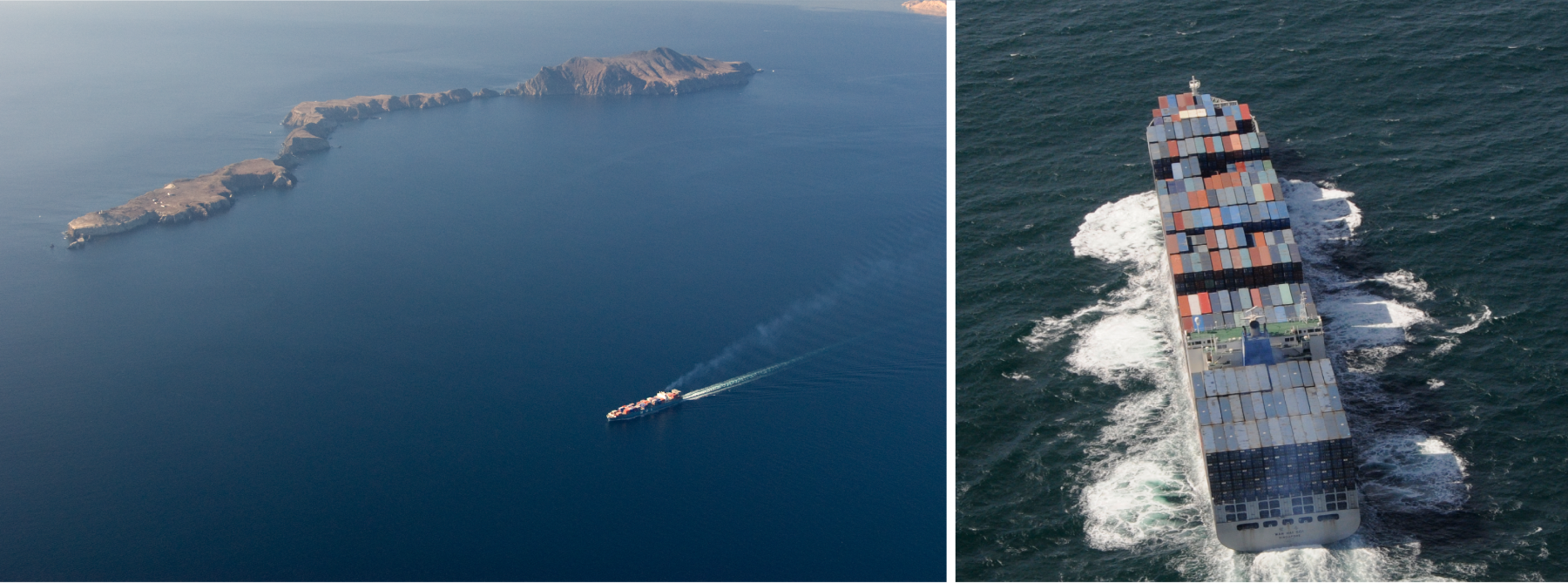
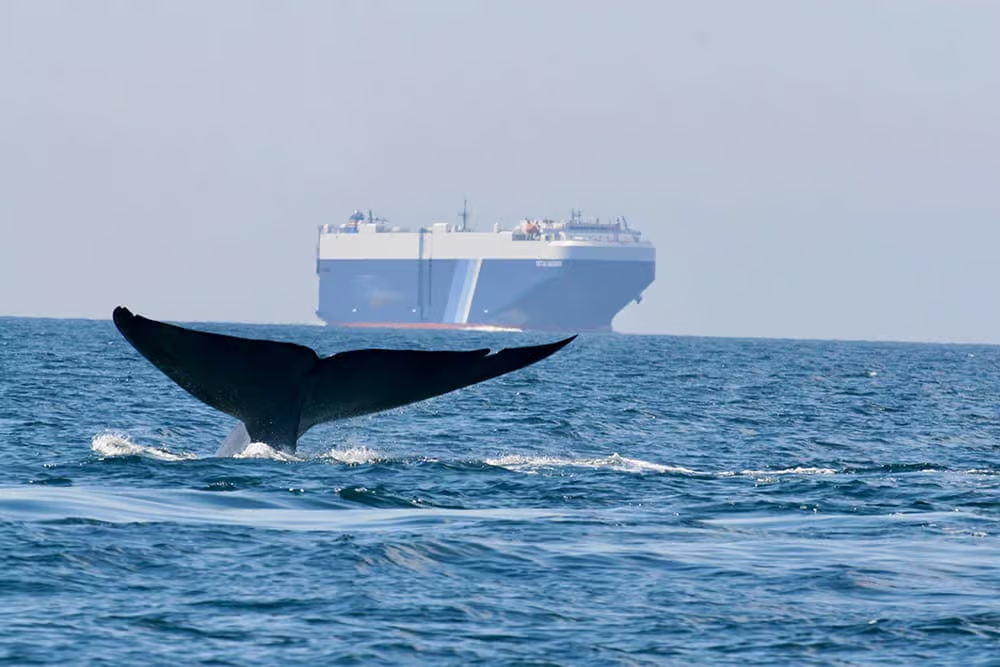
Every year, ocean-going vessels make thousands of transits in the shipping lanes in the Santa Barbara Channel region and along the California coast. These vessels are a significant source of air pollution and ship strikes on endangered blue, humpback, and fin whales. The Vessel Speed Reduction program is a voluntary program where the District and its partners ask the vessel operators to slow down to a speed of 10 knots or less, which decreases engine load and fuel consumption, effectively reducing emissions of nitrogen oxides, diesel particulate matter, sulfur compounds, and greenhouse gases. Slowing down also reduces the risk of fatal ship strikes to endangered whales and the volume of underwater noise.
The program runs annually from May to December to coincide with the season when concentrations of ground-level ozone, or smog, are typically high and when whales are migrating and feeding in the area. All participating vessel operators are asked to voluntarily slow to 10 knots or less in the VSR zones, and Automatic Identification System (AIS) data is used to verify the speeds of each vessel. Public recognition is then given to the fleets that cooperate with the slow-speed requests.
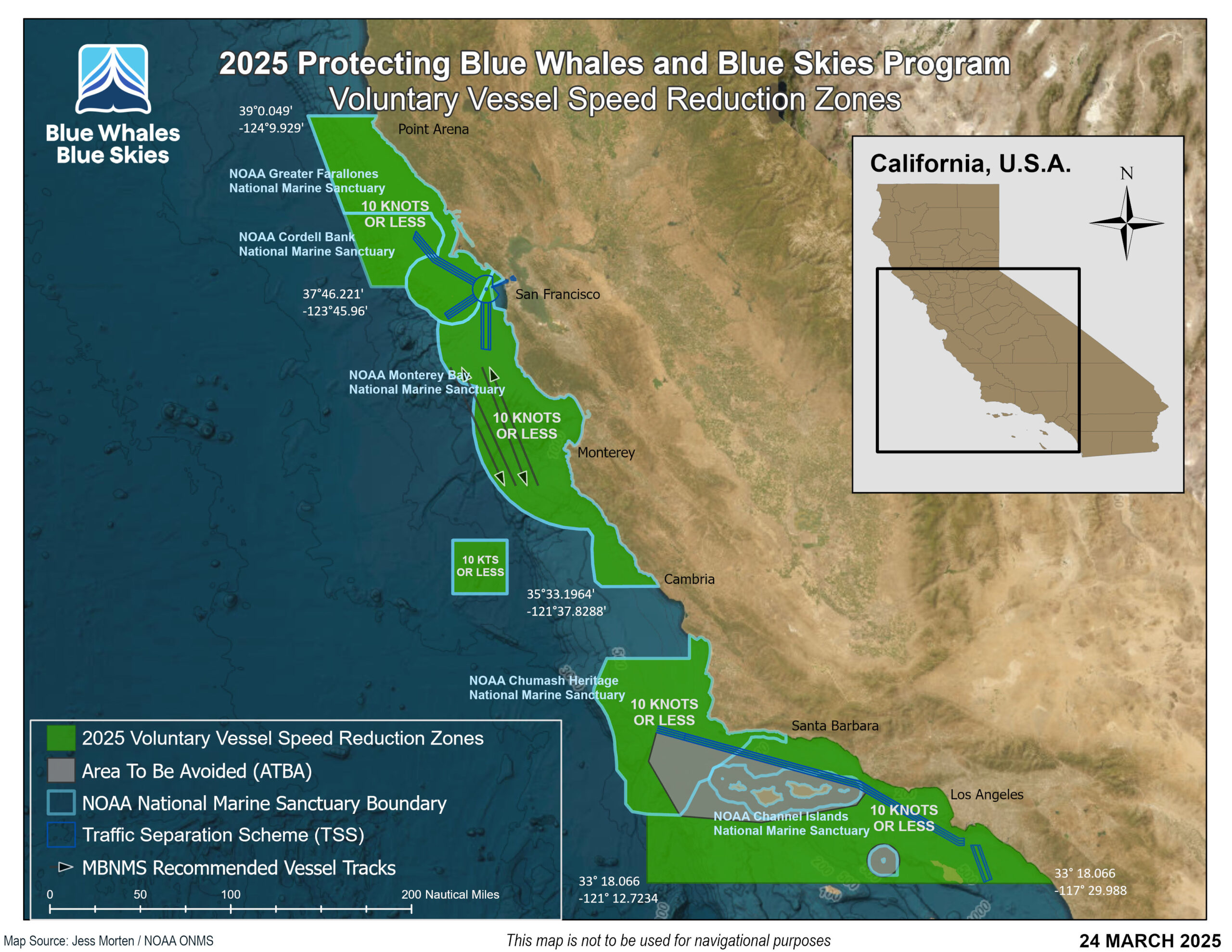
The program has since spread to include more of the Southern California coast and a region covering San Francisco and Monterey bays. A map of the current VSR zones is shown below. For more information, please visit www.BlueWhalesBlueSkies.org.
History
The district partnered with the Ventura County Air Pollution Control District, the National Oceanic and Atmospheric Administration Channel Islands National Marine Sanctuary and the Environmental Defense Center to launch the program in 2014. It started in the Santa Barbara Channel with seven shipping lines. In 2016, the U.S. Environmental Protection Agency recognized the partnership’s 2014-15 efforts with a Clean Air Excellence Award.
The program spread to include more of the Southern California coast and a region covering San Francisco and Monterey bays. In 2025, Gov. Gavin Newsom signed a landmark law that expands it into a statewide program.
Current partners are:
- Bay Area Air District
- Benioff Ocean Science Laboratory
- California Marine Sanctuary Foundation
- Monterey Bay Air Resources District
- National Oceanic and Atmospheric Administration Marine Sanctuaries
- Santa Barbara County Air Pollution Control District
- San Luis Obispo County Air Pollution Control District
- Ventura County Air Pollution Control District
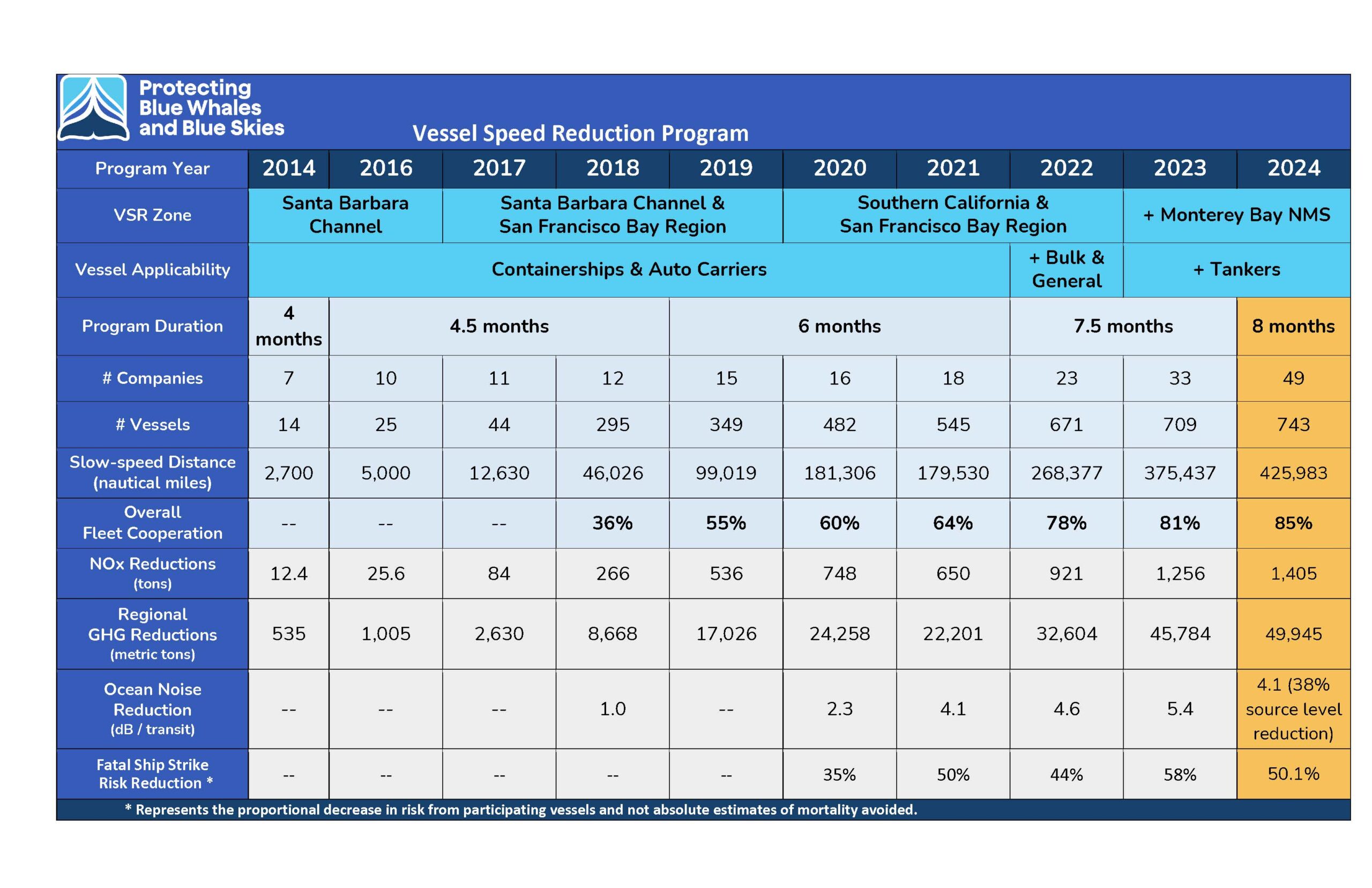
Success of the VSR Program Throughout the Years
For a comparison on how the program has been growing throughout the years, please see the table below.
 Additional Information
- June 2025: Board Update on Vessel Speed Reduction Program (opens in a new tab)
- Whale Safe website (opens in a new tab) that shows vessel transit and whale data.
- NOAA Channel Islands National Marine Sanctuary (opens in a new tab) issues additional advisories when whales are present for ALL ships (300 gross registered tons or larger) to reduce speeds to 10 knots or less.
Webpage Links: Previous Vessel Speed Reduction (VSR) Programs | Local Studies & Actions | Initiatives | 2007 Retrofit Project

2024 Results:
Forty-nine global shipping companies participated and slowed down to 11.5 miles (10 nautical miles) per hour or less for a combined 490,212 miles (425,983 nautical miles). This resulted in emission reductions of:
49,000 metric tons of regional greenhouse gases
1,400 tons of oxides of nitrogen
Among the 2024 participating fleets, the following 23 received the top-level Sapphire award for slowing down for 85% or more of the distance they traveled through the zones:
CMA CGM
Connaught Shipmanagement HK
ConocoPhillips – Polar Tankers
COSCO Shipping
CSL Americas
Hong Kong Top Honor Shipping
ISM Ship Management Ltd.
Maersk
Marathon Petroleum
Mediterranean Shipping Co. (MSC)
NYK Ro-Ro
Ocean Network Express
Orient Overseas Container Line (OOCL)
OSG Ship Management Inc.
Pillion Navigation
Starbulk SA
STX Marine Service Co.
Swire Shipping
Teo Shipping Corp.
Tomini Transports LLC
Toyofuji
Wallenius Wilhelmsen
Yang Ming Marine Transport Corp.
Wallenius Wilhelmsen
Ambassadors:
The following companies and ports have become program ambassadors to demonstrate their commitment to shipping more sustainably and reducing their supply chains’ negative effects on biodiversity:
Limoneira Co.
Pacific Stoneworks
Patagonia
Port of Hueneme
Batch Bicycles
Brighten Solar Co.
Brist Mfg.
Business & Pleasure Co.
Buzz
Deckers Brands
Eggboards
Honeylove
Huffy
JAS Worldwide
Matilija Wine
Mistral
Niner Bikes
Nomad
Peak Design
Port of Oakland
Santa Cruz Bicycles
Seaspan Ship Management
ShipCo Transport
Sonos
STAX
Summit Coffee
The Block Logistics
Toad&Co
Who Gives a Crap
Zen Paradise