
The Santa Barbara County Air Pollution Control District (District) reviewed and revised an air toxics Health Risk Assessment (HRA) for the University of California, Santa Barbara (UCSB) under the AB 2588 Air Toxics “Hot Spots” Program.
Summary
UCSB is located just north of the City of Santa Barbara near Goleta, California on 1,055 acres adjacent to the Pacific Ocean. UCSB emits benzene, (opens in a new tab) acrolein (opens in a new tab), arsenic (opens in a new tab), polycyclic aromatic hydrocarbons (PAHs) (opens in a new tab), diesel particulate matter (opens in a new tab), cadmium (opens in a new tab) and other toxic air pollutants during the normal course of its operation. The state of California considers these substances to be toxic air contaminants, and exposure to them may increase your risk of adverse health effects. Pursuant to state law, this notice was developed to notify neighbors located in this facility’s “significant risk footprint” of the possible health risks that result from routine facility operations. The HRA was conducted on operations at UCSB that occurred in 2018. Based on these operations, a significant acute non-cancer risk was identified onsite and on a small portion of a beach immediately adjacent to UCSB. However, as there are no businesses and no residences within the significant risk isopleth, an online public notification is being conducted in lieu of the traditional mailing. Because this facility’s health risk assessment indicates a significant risk, UCSB was required to conduct an airborne toxic risk reduction audit and develop a plan, as described below in the Risk Reduction section of this notification. The implementation of the risk reduction measures described in the plan reduced UCSB’s risk below the District’s significant risk threshold. The health risk assessment results are available here. (opens in a new tab)
Calculating Risk
The toxic risk was calculated for UCSB using a computer model that evaluates emissions information provided by the facility operator and reviewed by the District. Actual measurements of toxic emissions have not been made beyond the facility’s boundaries, nor have there been any health surveys of actual illnesses attributable to the facility’s emissions. The results of the computer modeling indicate that exposure to benzene from UCSB may increase the possibility of adverse health impacts to one’s immune systems, hematologic (blood) system, and reproductive/developmental systems for an individual within the significant risk footprint for one hour or more. This risk is measured by a hazard index, which is a ratio of the predicted concentration divided by the concentration that is conservatively considered to protect public health. A hazard index of 1.0 or less represents an acceptable level where the predicted air toxic exposure at or below this level would not impact public health. The acute (maximum 1-hour exposure) hazard index (HI) calculated for UCSB was 12.9 onsite. After the results of the HRA were calculated, the District worked with UCSB to develop risk reduction measures which reduced the risk below the District’s significance risk threshold as described below in the Risk Reduction section.
Significant Risk Footprint
The screening acute hazard index isopleth of 1.0 is shown below in purple. The property boundary is outlined in red. The point of maximum impact (PMI) and maximally exposed individual worker (MEIW) are shown in green. The maximally exposed individual resident (MEIR) is in yellow.
Screening Acute Non-Cancer Risk Isopleth
Entire Stationary Source View
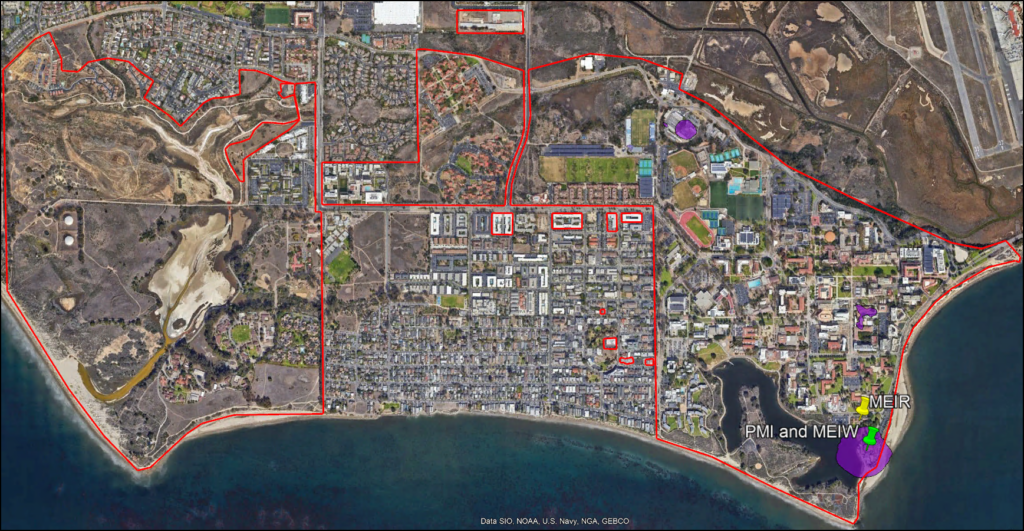
Screening Acute Non-Cancer Risk Isopleth
Magnified View of Locations with Acute HI > 1
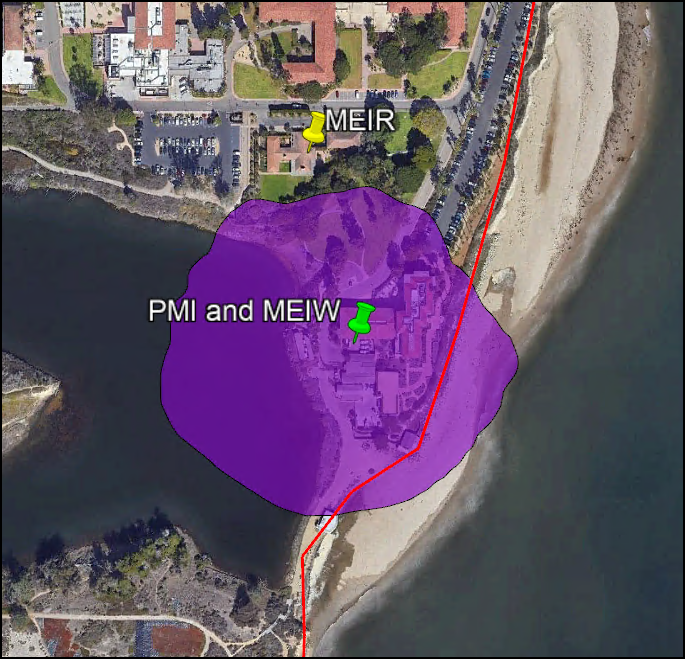
Isopleth is over the Marine Biotechnology Laboratory.
Screening Acute Non-Cancer Risk Isopleth
Magnified View of Locations with Acute HI > 1
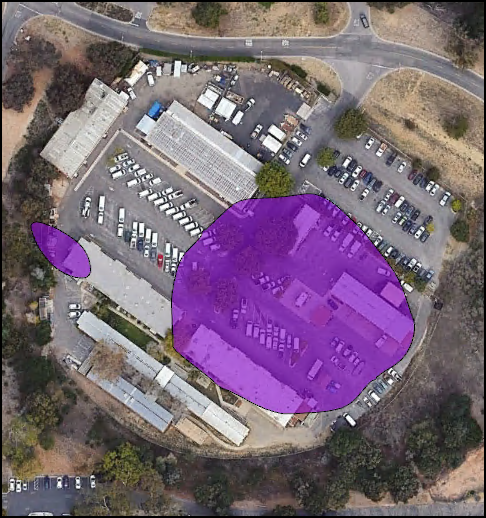
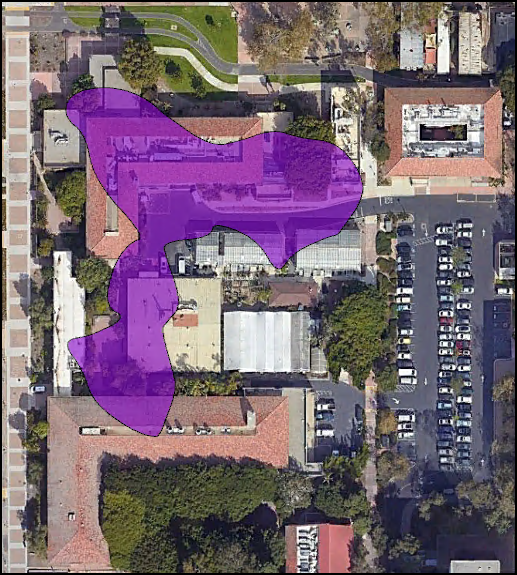
Left isopleth is over the Facilities Management offices (no longer present); Right isopleth is over classrooms and labs near Webb Hall.
Risk Driving Pollutant
There are three locations with a significant risk footprint: 1) the point of maximum impact (PMI) at the Marine Biotechnology Laboratory; 2) the Geology building, Webb Hall; and 3) the Facilities Management offices (which are no longer present). The risk driving pollutant and device for each risk footprint is discussed below.
Marine Biotechnology Laboratory
Benzene (opens in a new tab), emitted from the Marine Biotechnology Laboratory gasoline dispensing facility (GDF), is the primary driver for the acute non-cancer risk at the point of maximum impact (PMI). The primary health endpoints for the acute non-cancer risk at the PMI are the immune, hematologic (blood), and reproductive/developmental systems. The primary cancer risk drivers at the PMI are combustion products: arsenic (opens in a new tab), polycyclic aromatic hydrocarbons (PAHs) (opens in a new tab), diesel particulate matter (opens in a new tab), and cadmium (opens in a new tab). The chronic non-cancer risk driver at the maximally exposed individual resident (MEIR) is arsenic (opens in a new tab). The primary health endpoint for chronic non-cancer risk at the MEIR is the respiratory system. The primary 8-hour chronic non-cancer risk driver at the MEIR is nickel (opens in a new tab), with arsenic (opens in a new tab), acrolein (opens in a new tab), and formaldehyde (opens in a new tab) as secondary risk drivers, all of which are combustion products. The primary health endpoint for 8-hour chronic non-cancer risk at the MEIR is the respiratory system. UCSB’s entire Facility Emissions Summary is available here (opens in a new tab).
Webb Hall
Acrolein (opens in a new tab), emitted from a natural gas generator at the Geology building, was the primary risk driver for the significant acute non-cancer risk at Webb Hall. The primary health endpoints for the acute non-cancer risk at Webb Hall were the eyes and the respiratory system. The natural gas generator used at the Geology building is no longer present. For that reason, the calculated risk at Webb Hall was reduced below the District’s significance threshold.
Facilities Management Offices
Benzene (opens in a new tab), emitted from the GDF at the Facilities Management Yard, is the primary risk driver for the significant acute non-cancer risk at the Facilities Management offices. The primary health endpoints for the acute non-cancer risk at the Facilities Management offices are the immune system, hematologic (blood) system, and reproductive/developmental systems. The Facilities Management offices and the GDF at the Facilities Management Yard are no longer present. Therefore, the calculated significant risk at this location is no longer present.
Risk Reduction
UCSB submitted their Risk Reduction Audit and Plan (RRAP) on December 9, 2025, which is available here (opens in a new tab). The risk reduction measures included: 1) installing Phase II emission controls and limiting the hourly dispensing rate of gasoline at the Marine Biotech Lab GDF (completed August 18, 2026); and 2) updating the acute non-cancer risk modeling with the Alternative Refined Acute Method (ARAM) described in Appendix H of the District’s Form-15i (opens in a new tab) (submitted December 9, 2025). The updated modeling also included the removal of emitting devices that are no longer operating at UCSB, including the risk driving devices at Webb Hall and the Facilities Management offices. The removal of these devices and updating the modeling using ARAM showed that the risk at Webb Hall (Geology building) and the Facilities Management offices was reduced below the District’s significance threshold. The District conditionally approved the RRAP on February 24, 2026. The District’s conditional approval letter is available here (opens in a new tab). Implementation of both measures has reduced UCSB’s risk below the District’s significance thresholds at all locations.
Understanding Risk
The following information helps explain how the potential health impact from UCSB compares with other types of toxic air pollution. The cars we drive, many industrial activities and numerous home products that we use all contribute toxic pollutants to our air. Exposure to these background air toxics may increase your risk of getting cancer, or experiencing other non-cancer-related effects (such as irritation of the eyes, respiratory system or skin). The California Air Resources Board provides helpful information on risk and air toxics here (opens in a new tab).
Health Risk Assessment
Details on the health risk assessment and more information about the UCSB facility are available here (opens in a new tab).
Comments on Public Notification
To submit comments or request a public meeting, please contact [email protected].
More information about the AB 2588 program can be found at the District’s AB 2588 Air Toxics “Hot Spots” Program (opens in a new tab) webpage.